
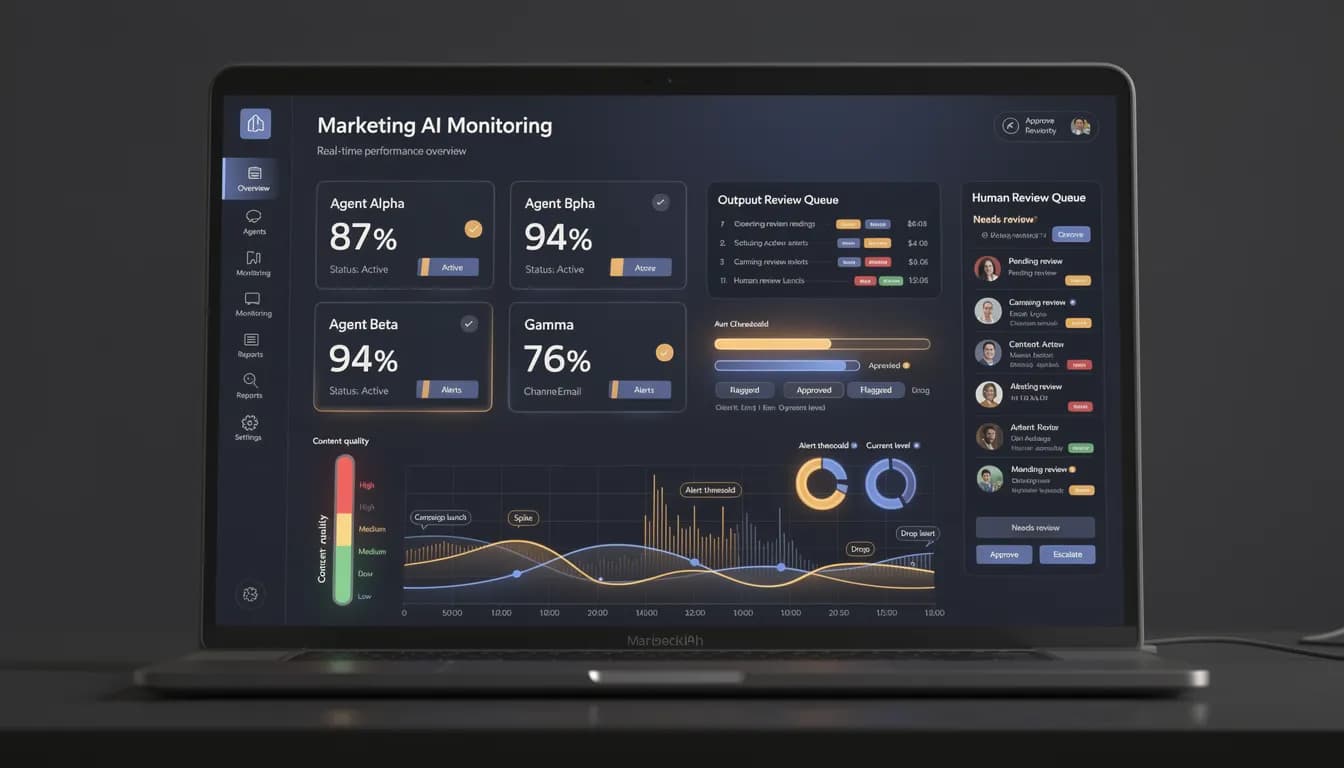
Your AI agents are running — but are you actually watching them? Configure them carefully and the initial outputs will look fine. Within days, you stop checking. That's not a workflow gap. That's when brand voice starts drifting. AI agent monitoring for marketing isn't the same thing as what your DevOps team does — and the developer tools that dominate this space are completely silent on the failure modes that actually hurt marketing teams. Brand drift, hallucinated statistics, budget overruns that don't trigger an error log — these are marketing problems, not infrastructure problems. The teams that scale AI agents sustainably are the ones that solve the monitoring question before they discover why it matters.
You've probably already heard that "observability" is the thing you need for AI agents. What nobody tells you is that every guide, tool, and framework for AI agent monitoring was built by developers, for developers. LangSmith tracks token usage and chain latency. Datadog monitors infrastructure uptime. Langfuse logs prompt-response pairs for debugging. These are useful tools — if your problem is that a Python service is throwing 500 errors.
Your problem is different. Your AI agents are writing your brand voice, selecting your audiences, deciding which content gets promoted. When they drift, it doesn't throw an error. It just quietly undermines work you've been building for months.
This is the monitoring gap nobody in the agentic marketing space is talking about honestly. And it's fixable — but only if you define monitoring differently than the DevOps team would.
Why Developer AI Monitoring Tools Miss the Marketing Problem Entirely
The gap between developer-focused and marketing-focused AI agent monitoring isn't about technical sophistication. It's about what counts as a failure.
For a backend engineer, a failed AI agent is one that crashes, times out, or returns a malformed response. The monitoring systems they use are built around those signals: error rates, latency percentiles, API call costs. These metrics matter. But they are completely silent on the questions marketing teams actually need answered.
Did the AI agent stay on brand? Did it produce content that a human editor would approve? Did the campaign it optimized drift away from the original targeting strategy? Did it recommend a messaging angle that's factually accurate? Did it stay within budget thresholds when making autonomous decisions?
None of these questions show up in a Datadog dashboard. None of them trigger a LangSmith alert. And none of them are captured in a simple "success / failure" response log.
Marketing teams adopting AI agents are, right now, running on trust. They configure the agent, watch it work for a few days, decide it looks good, and then mostly stop watching. That's understandable — you're busy, the early outputs seemed fine, and there's no obvious alarm system telling you to check. But that's exactly the window where drift happens. Not dramatically. Not all at once. Just gradually, until the AI agent is doing something meaningfully different from what you intended.
The 5 Failure Modes AI Agent Monitoring Should Catch in Marketing
Before you can monitor for problems, you need a clear-eyed picture of what "going wrong" actually looks like for marketing AI agents. Based on the most common production failure patterns, these are the five categories that matter:
1. Brand voice drift
An AI agent that writes content daily will not stay stylistically consistent without explicit monitoring. The problem isn't the model — it's that marketing prompts are often underspecified for tone, and the agent interpolates from whatever context it has. Over time, the writing gets blander, more generic, more AI-sounding. Your blog starts reading like everyone else's blog. Nobody flags it because each individual piece looks acceptable. You only notice six months later.
2. Factual hallucination at scale
When a human writer makes something up, one person made one mistake. When an AI agent makes something up, it can replicate that fabrication across dozens of pieces before you catch it. Marketing-specific hallucination risks include wrong pricing claims about competitors, invented statistics, nonexistent product features, and outdated compliance information. Any of these can create legal exposure or significant brand damage.
3. Budget and scope creep
AI agents with any degree of autonomy over campaign management can quietly exceed intended parameters. An agent that's supposed to optimize bids within a defined range can misinterpret instructions. An agent generating ad variations can produce significantly more or fewer assets than planned. Without monitoring, you discover these issues in the monthly budget review, not in real time.
4. Approval chain bypass
Marketing has governance structures for good reasons — legal review, brand approval, compliance sign-off. When AI agents generate and distribute content with high autonomy, those governance structures can be inadvertently bypassed. Not because the agent is "rogue" — because nobody explicitly wired the approval requirements into the workflow monitoring.
5. Performance-to-KPI decoupling
This is the subtlest failure and the most damaging. An AI agent optimizes for the metrics it's given. If those metrics aren't perfectly aligned with your actual business KPIs, the agent will get better at the metric while your actual results stagnate or decline. Monitoring needs to track whether agent-driven improvements in proxy metrics are translating to the outcomes you actually care about.
A Practical AI Agent Monitoring Framework for Marketing Teams
Here's the monitoring framework that actually works for marketing-deployed AI agents — built around what matters to your team, not your DevOps team.

Layer 1: Output Quality Gate
Every piece of content, every campaign decision, every automated action should pass through a defined quality gate before being treated as final. This doesn't mean human review of everything. It means automated checks against a defined quality standard:
- Brand voice score (does this sound like us?)
- Factual claim verification against an approved source list
- Approval workflow compliance (did this go through the right review steps?)
- Format and length consistency with your content standards
You can implement this with a combination of a secondary review agent and structured logging. The key is that every output has a quality score attached to it, not just a completion status.
Layer 2: Performance Monitoring Dashboard
At a minimum, your AI agent monitoring dashboard should track these metrics weekly:
Metric | What It Catches |
|---|---|
Output acceptance rate | % of AI outputs approved without major edits — tracks drift over time |
Cost per completed task | Prevents undetected budget overruns |
Brand voice consistency score | Catches gradual voice drift before it becomes obvious |
Hallucination flag rate | % of outputs flagged for unverifiable claims |
KPI correlation coefficient | Are agent-driven actions improving real business results? |
Approval bypass rate | % of outputs that skipped required review steps |
Track these weekly, not monthly. Monthly is too slow to catch drift before it causes real damage.
Layer 3: Alert Thresholds
Set hard thresholds that trigger immediate review — not just logging, but an actual escalation:
- Output acceptance rate drops below 70% in any week
- Any single output contains an unverifiable factual claim about a competitor or product
- Cost per task exceeds baseline by more than 30%
- Agent actions are detected outside defined operational parameters
These thresholds should be calibrated to your team's baseline once you have two to four weeks of production data. Don't try to set them theoretically before you've seen your actual distribution.
Layer 4: Human Review Sampling
Even with automated gates, you need regular structured human review. Not of every output — that defeats the purpose of AI agents. But a random 10% sample reviewed weekly by a senior team member catches the patterns that automated systems miss.
The review process should generate a short structured log: what worked, what drifted, what to update in the agent's instructions. That log is the input to your next prompt improvement cycle.
What Good AI Agent Monitoring Actually Looks Like in Practice
You're running a content agent that produces four blog drafts per week. Here's what monitoring should look like in practice:

Every draft gets an automated quality score before it reaches your editor. The score checks for brand voice alignment, factual claim density, keyword integration, and format compliance. Anything below an 80% quality score gets flagged for human review before it moves forward. The acceptance rate — how many drafts pass without a major rewrite — gets logged weekly.
Each month, you look at three things: Is the acceptance rate stable or declining? Is the cost per draft staying within expected range? Are the drafted articles that get published performing comparably to your human-written baseline?
If any of those three trend in the wrong direction, you investigate the agent's prompt stack — you don't just keep running it and hoping it corrects itself.
That's it. That's what basic AI agent monitoring for marketing looks like. It's less technically complex than the developer tooling suggests. What it requires is discipline: someone owns the monitoring function, someone reviews the weekly metrics, and someone updates the agent instructions when the data indicates drift.
Tools for Marketing AI Agent Monitoring: What's Worth Your Attention
The developer tools — LangSmith, Langfuse, Helicone — are genuinely useful if you have technical resources to configure them and interpret their output. If you don't have a data engineer embedded in your marketing team, they'll give you a lot of data and very little actionable signal.
For marketing teams, the more practical approach is monitoring built into the agentic marketing platform itself. Allable's agentic marketing module includes output quality logging, cost tracking per agent task, and performance dashboards that connect agent outputs directly to content performance metrics. You don't need to build a separate observability stack — the monitoring is part of the system you're already running. If you're evaluating agentic marketing platforms, monitoring capability should be one of your primary selection criteria, not an afterthought.
For teams building custom agent workflows, combining a lightweight logging layer (even a structured Google Sheet or Notion database at the start) with a secondary review agent is often more effective than deploying enterprise observability tooling before you know what you're actually trying to measure.
The key principle: your AI agent monitoring framework should be in production before you scale your agents, not after you've already run into your first major problem.
How This Connects to Your Broader AI Content Strategy
AI agent monitoring doesn't exist in isolation. It's one part of a broader approach to marketing workflow automation that maintains quality at scale without requiring proportional growth in headcount.
The teams that get this right are the ones who treat their AI agents like junior team members on a 90-day probation. You don't give a new hire full autonomy and then check in every quarter. You set clear expectations, review their work regularly, give structured feedback, and adjust their responsibilities based on demonstrated reliability.
The monitoring framework you build now determines how much you can trust your agents — and how much autonomy you can safely give them — six months from now. That's the real ROI of AI agent monitoring: not catching problems, but building the track record that lets you confidently expand what your agents are authorized to do.
If you're earlier in the process of thinking through what agentic marketing actually is, understanding the monitoring requirements upfront will help you make better platform and architecture decisions before you're committed to a specific approach.
Frequently Asked Questions
- What is AI agent monitoring and why do marketing teams need it?
- AI agent monitoring is the practice of systematically tracking what your AI agents do, the quality of their outputs, the costs they incur, and whether their actions align with your intended business goals. Marketing teams need it because AI agents in marketing contexts — content generation, campaign optimization, audience management — can drift from intended behavior in ways that don't trigger technical errors but do cause real business damage. Brand voice inconsistency, hallucinated facts, and budget overruns are all failures that only monitoring catches before they compound.
- How is marketing AI agent monitoring different from DevOps observability?
- DevOps observability focuses on infrastructure health: uptime, latency, error rates, and API costs. These metrics matter but are entirely silent on marketing-specific failure modes — brand voice drift, factual accuracy, approval workflow compliance, and KPI correlation. Marketing AI agent monitoring requires a different metric set and a different review process, centered on output quality and business outcome alignment rather than system performance.
- Do I need technical resources to set up AI agent monitoring?
- Not for basic monitoring. A structured weekly review of output acceptance rates, cost-per-task, and KPI correlation requires no engineering resources — just a consistent process and someone who owns it. More sophisticated monitoring — automated quality scoring, prompt-response logging, anomaly detection — benefits from technical support. Most marketing teams should start with the manual framework and add automation as they identify specific gaps in their manual review process.
- What's the most important metric to track for marketing AI agents?
- Output acceptance rate — the percentage of AI-generated outputs that pass review without major revision — is the single most valuable leading indicator. When it drops, it signals agent drift before the drift becomes visible in downstream performance metrics. Track it weekly, set a floor threshold (typically 70-80% depending on your baseline), and investigate immediately when it falls below that threshold.
- How often should I review my AI agent monitoring data?
- Weekly for core operational metrics (acceptance rate, cost per task, hallucination flags). Monthly for strategic performance review (KPI correlation, trend analysis, prompt update decisions). Daily alert monitoring for hard-threshold violations (budget overruns, approval bypasses, factual error flags). The more autonomy your agents have, the more frequent your monitoring cadence should be.
Monitor All Your Marketing AI Agents in One Place
Automated quality checks, error alerts, and performance tracking — built into the platform, not bolted on after. See how Allable's agent dashboard connects output quality directly to content performance metrics.